
As part of a Victorian Government plan to standardise household waste and recycling services, all councils across Victoria are required to introduce a four-bin system. The City of Casey has been preparing for this change for several years and will complete the final two stages of the rollout in 2026.
The four-bin system includes separate bins for:
- General rubbish (red lid)
- Mixed recycling (yellow lid)
- Food and garden organics (green lid)
- Glass recycling (purple lid)
In 2026, Casey households will receive a new purple-lidded glass recycling bin, and all households will have access to a food and garden organics (FOGO) service.
By separating waste into four streams, more materials can be recovered and recycled, helping reduce contamination and the amount of waste sent to landfill.
Council will continue to provide clear information, practical resources and support to help households understand the changes and prepare for the new services.
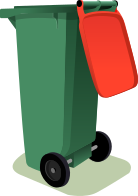
General rubbish
Emptied
weekly
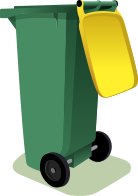
Mixed recycling
Emptied
fortnightly
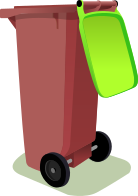
Food and garden
Emptied
fortnightly
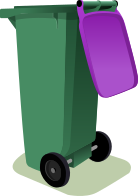
Glass recycling
Emptied
every 4 weeks
Glass recycling service
Casey households will receive a new purple-lidded glass recycling bin between September and November 2026. Putting glass in its own bin keeps recycling cleaner, reduces contamination, and improves glass recycling so it can be made into new products.
What to expect:
- An 80-litre glass-only bin will be delivered between 7 September and 20 November 2026.
- Glass bottles and jars of any colour that have contained food or drink can go in this bin. Just give them a quick rinse and remove the lid.
- Once your purple bin is delivered, glass will no longer be accepted in the yellow-lidded recycling bin.
- Your glass bin will be collected every 4 weeks alongside your general rubbish and food and garden bin.
Council has been planning for this change for several years and is working to make the transition as easy as possible for residents. Council understands that an extra bin may create storage challenges for some households. We are considering this as part of the rollout and will continue to advocate to the Victorian Government on behalf of our community.
Food and garden organics (FOGO) Service
As part of the rollout of the FOGO service to all households, existing households without a FOGO bin will receive one. When food scraps and garden waste are kept out of general rubbish, they can be turned into soil conditioner instead of going to landfill, reducing emissions, improving soil health and supporting a more sustainable community.
What to expect:
- Households that don't already have a FOGO bin will receive one in late November 2026. The bin size depends on your property size (<400 sqm will receive a 120L bin).
- Households receiving a new FOGO service in November 2026 will be charged for the additional service from 1 January 2027. This will be reflected in the 2026/27 rates notice as an increase in the waste charge for the second half of the financial year.
We appreciate your cooperation in making Casey a cleaner, greener community!
Frequently asked questions
- Will I be receiving a purple glass bin?
Yes. As part of Council's rollout of the Victorian Government's waste and recycling reforms, all Casey households will receive a new 80-litre purple-lidded glass recycling bin between 7 September and 20 November 2026.
- Why is Casey introducing a glass recycling service?
The Victorian Government has introduced legislation requiring all councils to provide a standardised four-bin waste and recycling system by 1 July 2027. Casey is completing the final stages of this rollout in 2026 to meet these requirements.
Separating waste into four streams helps recover more recyclable materials, reduce contamination and divert waste from landfill.
- When will households begin receiving purple glass bins?
Casey residents will start to receive a new purple bin between 7 September and 20 November 2026.
- When does the glass recycling service start?
The glass recycling service will commence in November 2026. Once your purple-lidded bin has been delivered, glass bottles and jars should be placed in it, not in your yellow-lidded recycling bin.
The glass bin will be collected every four weeks, aligned to every second FOGO collection. To help you remember your collection night, please download the Bin It Right App.
- What happens to the glass that is collected?
Glass is a valuable material that can be recycled repeatedly, providing a sustainable packaging option for products.
All glass collected from City of Casey households will be processed into new glass bottles and jars or road aggregate.
- What can I put in my purple-lidded glass bin?
The new bin is for glass bottles and jars that have contained food or drink.
Acceptable items:
- Glass bottles and jars (Clear, green & brown)
- Glass bottles such as olive oil, beers, spirits, and sauces
- Glass jars and containers such as pasta sauce, jam and condiments
All containers should be emptied, rinsed and have lids removed before being placed in the bin. Labels and stickers on bottles and jars are fine to be left on.
Items NOT accepted:
- General waste/ plastic bags
- Corks, bottle and jar lids (place lids in the rubbish bin or recycling if they are metal)
- Drinking glasses, Window glass, Light globes, mirrors and perfume bottles
- Ceramic plates, cups and bowls
- Broken crockery
- Pyrex storage and baking ware
These glass items have a higher melting point and cannot be recycled into new materials.
- Can I still put glass in my yellow-lidded recycling bin?
No. Once your purple-lidded glass bin has been delivered, glass bottles and jars can no longer be placed in your yellow-lidded recycling bin and will be treated as contamination.
Removing glass from mixed recycling helps create cleaner recycling streams and improves recycling outcomes.
- Why is Council introducing the glass bin if some residents don't support it?
The Victorian Government has legislated a four-bin waste and recycling system that requires all councils to provide a glass recycling service by July 2027. Council is required to comply with these requirements.
While Casey has previously raised concerns about the mandatory glass recycling service, Council must ensure services are in place to meet State Government requirements. Council will continue advocating for practical improvements to the reforms while monitoring the use, costs and effectiveness of the service once introduced.
- Why is Casey introducing the service now?
Casey is Victoria's largest Council by population, servicing more than 135,000 households. Implementing a change of this scale requires significant planning, procurement and contract management.
Planning and procurement for the reforms have been underway for several years. Delaying implementation could have increased operational risks, supply constraints and the risk of not meeting State Government requirements.
- Will the new glass recycling service increase my waste charge?
There are costs involved in implementing the waste reform requirements, including new bins and collection services.
Council has worked over several years to manage these costs and balance their impact on residents. This has included long-term planning, using funding from the waste reserve and spreading the costs of the reforms over time.
For 2026/27, Councillors voted to freeze the standard household waste charge, meaning there is no increase compared with last year, despite the continued rollout of the waste reforms, including the new glass recycling service. To support this decision and help ease cost-of-living pressures, Council is using funding from its waste reserve, including a further $4.4 million in 2026/27, to keep the waste charge unchanged.
The annual waste charge funds a broad range of services, including rubbish, recycling, FOGO and glass collections, hard waste collections, kerbside bins, street sweeping, public litter bins, dumped rubbish clean-ups and the Victorian Government's Landfill Levy.
The glass recycling service is expected to be the lowest-cost kerbside collection service to operate. Glass is collected every four weeks and, because it is separated from other recyclables, can be processed more efficiently, helping improve the quality of materials collected through the yellow-lidded recycling service.
- I do not want a new bin. Who can I contact to share my concerns about this?
Under the legislation, each residential property with a waste charge must have 4 bins. There is currently no option to opt out of this service.
As the Victorian Government mandates these reforms, we encourage you to contact your local MP to share your concerns.
- Why are all residents getting a FOGO bin?
The food and garden organics (FOGO) bin is part of the Victorian State Government Kerbside Reforms, focusing on standardising waste and recycling services across the state.
The Victorian Government requires us to introduce a food and garden organics (FOGO) service as part of mandatory kerbside waste reforms. All Victorian local councils are required to provide a standardised waste and recycling service to all residential properties, including rural and acreage properties.
FOGO bins are designed to collect food scraps and garden organics, which are then processed into compost and other valuable products that are used across Victoria. The FOGO bin is essential for reducing landfill waste and promoting a sustainable environment.
- I don't have a FOGO bin. When can I expect to receive this?
From 1 July 2026, new properties will receive a food and garden organics (FOGO) bin.
All existing residential properties without a FOGO bin will receive one between 23 November and 4 December 2026.
- Is this new FOGO bin optional? Am I able to opt out?
No. Victorian State Government legislation requires each residential property with a waste charge to have a food and garden organics (FOGO) bin on the premises. There is currently no option to opt out of this service.
- Will my waste charge increase with the new FOGO bin?
Yes, there will be an increase in the waste charge. The food and garden organics (FOGO) service will be included in your waste charge from 1 January 2027.
Your August 2026 rates notice will include a waste charge covering 6 months of service (from January to June 2027). There is no cost difference between the two sizes for the FOGO bin. The respective waste charges are $426.5 for a 120L garbage bin or $381.5 for an 80L garbage bin.

Bin It Right app
Find out how to sort and dispose of your waste correctly.
Get the app.